Working with the experts at Germinal, we have put together this useful reseeding guide and 12 point checklist for 2025.
Experts have concluded that older grass swards tend to produce a lower herbage yield and hence are less viable. In contrast, reseeding with perennial ryegrass can provide higher yields which has the effect of increasing meat and milk production and reducing bought-in feed costs.
Germinal believes that reseeding with perennial ryegrass (PRG) can return your investment within one to two years in terms of dry matter (DM) yield.
Climate smart grass
Perennial ryegrass can reduce dependence on bought-in feed. This is more nutritious and can help livestock to digest grass protein more efficiently and reduce the environmental impact. Among the emissions that can be cut are ammonia, methane and nitrous oxide.
The award-winning Aber High Sugar Grass varieties are the foundation of the Climate Smart range of mixtures.
Benefits of Reseeding include:
- Increased DM production
- Improved quality of feed and digestibility
- Increased Spring and Autumn grass supply
- Better response to applied nutrients
Our 12 Point Reseeding Guide
-
Target your fields
Plan to reseed roughly 10–15% of your total acreage each year to maintain consistent productivity. -
Carry out a soil analysis
Test in winter (but at least three months after your last nutrient application) and aim for pH 6.2–6.5 with phosphorus and potassium at Index 3. -
Eliminate the old sward
Use a suitable herbicide to remove existing grass, reopening the soil’s access to air, light and moisture. -
Prepare a quality seedbed
Cultivate to a fine, firm tilth and choose the method (plough, min‑till or direct drill) that best suits your soil and equipment. -
Correct soil acidity with lime
Apply lime according to your soil test—if you’re not ploughing in, use prilled lime to neutralise acidity from decaying vegetation. -
Apply balanced fertiliser
Dress with NPK rates tailored to your soil test results to give young seedlings the nutrients they need. -
Select the right seed mix
Choose grass and forage varieties matched to your end use (e.g. grazing vs silage), prioritising high‑performing ryegrasses and appropriate clover. -
Sow at the correct rate and depth
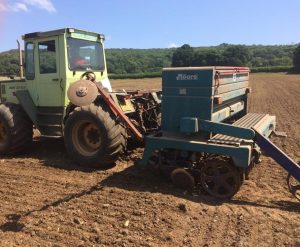
Broadcast or drill around 14 kg of seed per acre, keeping depth to 10–15 mm under good moisture conditions. -
Roll to firm the seedbed
Immediately after sowing, roll the ground to ensure close seed‑to‑soil contact and improve germination. -
Monitor and control pests
Watch for slugs, frit fly, leatherjackets, rabbits and other threats—treat or bait as soon as damage appears. -
Tackle weeds post‑emergence
Spray for weeds about five to six weeks after sowing, before the young grass faces its first grazing. -
Manage early grazing
Graze lightly but regularly, keeping covers low to stimulate tillering and build a dense, uniform sward